martes, 25 de mayo de 2021

Unit 1 - Grammar


 GRAMMAR

Source: https://cdn.pixabay.com/photo/2014/07/11/14/41/grammar-389907_960_720.jpg

The Teaching Knowledge Test or TKT is an international accreditation test that allows teachers to prove their knowledge related to  English language teaching. In this blog, we will provide information about the TKT Module 1 - Units 1-8 because it is important for teachers or people in general, to know the areas and contents that this test evaluates.

Unit 1 is focused on Grammar. Fromkin, Rodman and Hyams (2003) define grammar as part of a language which includes sounds, words and rules to combine them in order to create sentences to express meaning. It represents people’s linguistic competence and includes grammatical forms.

According to Spratt, Pulverness, Williams, University of Cambridge (2011) grammar refers to the way parts of words, words and groups of words are organized and combined in order to communicate. Grammar requires unconscious knowledge and describes language by using a wide range of forms and uses.

In addition, grammar involves grammatical forms that are the way words are presented in spoken or written language. They can be found in grammatical structures, word classes and words with affixes. First, we said that grammatical forms are present in grammatical structures because they have a specific way of organizing words. Furthermore, it is important to clarify that grammatical structures are the tenses in which sentences are written and forms refer to the parts we combine to make them.

Regarding word classes, there are nine different parts of speech which are: nouns, pronouns, verbs, adjectives, adverbs, conjunctions, determiners, prepositions and exclamations. Finally, words with affixes that include prefixes and suffixes. Prefixes are letters which are added at the beginning of a base word. Contrary to suffixes which are added at the end.

This is a video about which summarizes the importance of grammar:

Source: https://www.youtube.com/watch?v=aNdYhZbcGWQ

What did I learn in this unit?

In this unit, I learned about grammar, its importance in the language classroom and the aspects it involves for example, parts of speech, grammatical structures, forms and word building. Also, grammar must be taught if necessary, not as the main point of the lesson because teachers have to focus on helping students to communicate rather than using language in an isolated way.

How to apply knowledge related to Grammar in the English classroom:

2.  1. Knowledge of grammar and forms can be applying in a teaching situation to help learners to identify parts of speech that the parts we combine to make a grammatical structure. For example, to make a sentence in present, students have to write a subject (noun, pronoun) + verb + complement.

2.   2. Teachers must teach grammar using students’ context. For example, if teachers need to teach students the present simple tense by showing them some pictures about their daily routines. Teachers must teach grammar using students’ context. For example, if teachers need to teach students the present simple tense by showing them some pictures about their daily routines.

References:

English Learning Space. January 19th, 2016.  Why is it so important to learn GRAMMAR?. Retrieved from: https://youtu.be/aNdYhZbcGWQ

Fromkin, V., Rodman, R., & Hyams, V. (2003). An Introduction to language, 7 ed. Boston, Massachusetts: Wadsworth and Thomson Corporation.  Retrieved from: http://www.wjh.harvard.edu/~pal/pdfs/pdfs/7th.pdf

Spratt, M., Pulverness, A., Williams, M., & University of Cambridge. (2011). The TKT course: Modules 1,2 and 3. Cambridge: Cambridge University Press.


Unit 2 - Lexis


LEXIS


Barcroft (2018) state that lexis is considered all of the words either of an individual word or a group of words that have a relation with the vocabulary and meaning. It is to say that when we use some words to produce de language, the words can have a variety of meanings according to the context or situation. Also, the meaning describes the idea or thing that have in the vocabulary, in this part denotation, takes place because  some words have not manifest meaning for example three we know that is a plant but we talk about the family tree is referred to all members of the family. The meaning of some words or vocabulary proceeds from the form that can be prefixes, suffixes, or compounds. So, the prefixes, suffixes form new words but keeping the base of the word, for example, happy and unhappy, and the process we make when adding the affixes is called affixation, and compounds nouns have different meaning  when the two words are together, the same occurs with the idioms. Then, the words have several relationships with other such as the synonyms that are words that have the same meaning and antonyms that are words with appositive meaning, lexical sets, words families, homophones, homonyms, false friends, compound and collocations, figurative meaning and idioms, that all of which are considered as lexical features. The words are the first contact with the language and the learners should try to learn more and more new words to improve the language and consolidate their memory to share their ideas at the moment when they pronounce or spell and it can improve the vocabulary extension, it can be developed with several activities that are must provide for the teacher according to the age and level such as brainstorming, labeling, or categorizing. Tucker (1998) state that lexis is a language and each function or word that is only acquired through interaction with others. 

How to apply knowledge related to Lexis in the English classroom:

Source: https://www.youtube.com/watch?v=HEwPvTq9pq4

This activity is very practical so that students can acquire more vocabulary because they can analyze what is the possible words saying the letters and guess the rest of the letters to create the correct word and they can associate the words with the images, in addition to extending their vocabulary they can also improve spelling, strengthening their memory. 

Second, the teachers can bring students of homonyms and homophones words for students to identify their sound and meaning, since their meaning can vary depending on the context or the situation in which each word is used.

 References:

Barcroft, G. S. (2018). The Routledge Handbook of Applied Linguistics-Lexis. Retrieved from: https://www.taylorfrancis.com/chapters/edit/10.4324/9780203835654-51/lexis-joe-barcroft-gretchen-sunderman-norbert-schmitt

Spratt, M., Pulverness, A., Williams, M., & University of Cambridge. (2011). The TKT course: Modules 1,2 and 3. Cambridge: Cambridge University Press.

Tucker, M., & Ellis, R. (1998). On the relations between seen objects and components of potential actions. Journal of Experimental Psychology: Human perception and performance24(3), 830. Retrieved from: https://psycnet.apa.org/record/1998-02354-011

Unit 3 - Phonology

PHONOLOGY


Phonology is the study of sound features that have each words that are used in the language to communicate with others and the main features are phonemesword stresssentences stress and intonation. We need to take into account that phoneme is the part smaller of sound to distinguish the meaning of words within the language, for example, when the words are plural or singular, so the phonemes in the language are demonstrated with each symbol such as: /ʃ/,/ä/,/æ/each symbol helps us to differentiate between two sounds and meaning of the words and have a correct pronunciation when reading. Furthermore, in the phonemic chartDiCanio (2018) state that phonology occurs naturally, at the time of producing speech, that is, spontaneously and is demonstrated through the voice force that we use in each word, where the An increase in intensity in the pronunciation can indicate the presence of a particular symbol that changes the meaning in certain words. We have different groups of sounds, for example, in vowelsdiphthongsconsonantsvoiced soundsunvoiced sounds, all the symbols indicate main stress or secondary stress to pronounce taking into account the phonetic symbols or phonemic transcriptions that we can find in the dictionaries, learn about the phonology is very useful because English is considered a global language, for this reason, we must understand the variety of sounds and accents that the people have, they can improve it if they make several activities for example they should repeat models of the new language or when they develop minimal pairs activities to understand the stress and intonation.


How to apply knowledge related to Phonology in the English classroom:

The main purpose of phonology in English language learning could be a help for improving pronunciation since speaking is one of the most challenging skills to develop in our educational context. I would apply an activity focus on grouping work in which students should select 4 o 5 phonemic elements, so they must find out the correct sounds and clear examples to show understanding. Every member of the group should exchange their acquired knowledge with other groups and learn in the same way from their classmates. 

A second activity related to the last one is focused on practicing. As a teacher, I would provide an interactive tool of the phonemic chart” students will have the opportunity to learn all the sounds and examples to notice how it works using language. In the end, students will be able to differentiate sounds and improve their pronunciation skills.

References:

NativLang. July 1st, 2021. Intro to Phonology: Phonemes & Allophones (lesson 1 of 4). Retrieved from: https://www.youtube.com/watch?v=MTCx2hCxvHQ

Spratt, M., Pulverness, A., Williams, M., & University of Cambridge. (2011). The TKT course: Modules 1,2 and 3. Cambridge: Cambridge University Press.

Tucker, G. (1998). google scholar. Retrieved from:  https://books.google.com.ec/books?hl=es&lr=&id=LP-EMMgV9SEC&oi=fnd&pg=PR5&dq=what+is+important+lexis+in+the+language&ots=FykhzAVJbL&sig=C634XEWPAZ_5Yj3gxBnNs72NeR0&redir_esc=y#v=onepage&q=what%20is%20important%20lexis%20in%20the%20language&f=false


Unit 4 - Functions

                                                            FUNCTIONS


Conversaciones internas | El Cohete a la Luna

This unit is about Functions, so we are going to learn its definition and how important it is, to be able to convey a message clearly. Function is the reason why we communicate. When we speak or write, we do for a reason. Functions are a way of describing how we use the language. Normally, we focus on the use of language and its meaning for the people who are in the context where it is used. Jakobson (1987) in his book titled “Language in Literature” stated that there are six elements, or factors of communication, that are necessary for communication to occur: context, addresser, addressee (receiver), contact, common code and message. Each factor is the centerpiece of relations between the message and the factor. There are different functions that express different things, for example, the emotive function, referential function, multilingual function, conative function, poetic function, and phatic function. (Jakobson, 1987)

In oral language some common functions may include:  

•Giving instructions   

•Making requests   

•Defending an argument

In academic writing we use a range of specific functions in order to communicate ideas clearly. These include:   

•Describing processes   

•Comparing or contrasting things or ideas   

•Classifying objects or ideas   

The language we use to express a function is called an exponent. An exponent can express different functions at the same time but it depends on the context it is used in. An exponent expresses different levels of formality, these ones are formal (language is used in more official and important situations) and informal (language occurs in relaxed situations, among friends, etc) Informal exponents are sometimes colloquial. Normally, people usually choose to use the level of formality that suits a situation.

To conclude, functions are very important at the time of communicating different things, so it is necessary to know how to teach appropriately in the classroom and here are some activities that can help teachers.

How to apply knowledge related to Functions in the English classroom :

Communicative games:

Oral games, games of guessing, puzzle-solving, etc. have been developed to encourage communication among learners. Communicative games are useful for teaching language functions and also for encouraging students to understand.

ESL games and activities for adults

Oral speech:

Exchanging interactions and stories between students create the need for language use or for the use of language functions.

Oral Communication-Manuscript Speech - Inicio | Facebook

Developing other language skills:

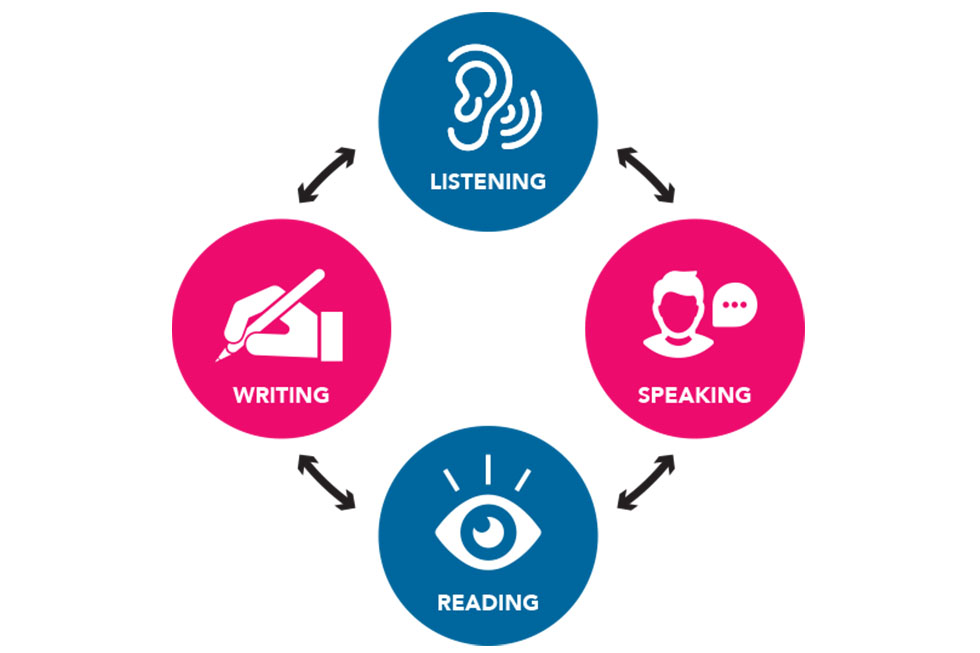
The language consists of four capabilities: to read, to write, to listen, to speak. These competencies can also be established through language functions. Language function is a vital part of language learning and we will also acquire other skills when teaching them. The key objective of teaching, however, is to ensure that students speak according to contexts and that students also gain more skills, either directly or indirectly.

 Four Core Skills of English Language Learning | Four Skills | English EFL

References.

ELPA21. (n.d.). Retrieved from ELPA21: http://prodev.elpa21.org/module2/module2/resources/LanguageFunctionsForms.pdf

Jakobson, R. (2019, 7 3). Elcombuls. Retrieved from Elcomblus: https://www.elcomblus.com/functions-of-language-by-roman-jakobson/

 Spratt, M., Pulverness, A., Williams, M., & University of Cambridge. (2011). The TKT course: Modules 1,2 and 3. Cambridge: Cambridge University Press.


Unit 1 - Grammar

 GRAMMAR Source:  https://cdn.pixabay.com/photo/2014/07/11/14/41/grammar-389907_960_720.jpg The Teaching Knowledge Test or TKT is an interna...